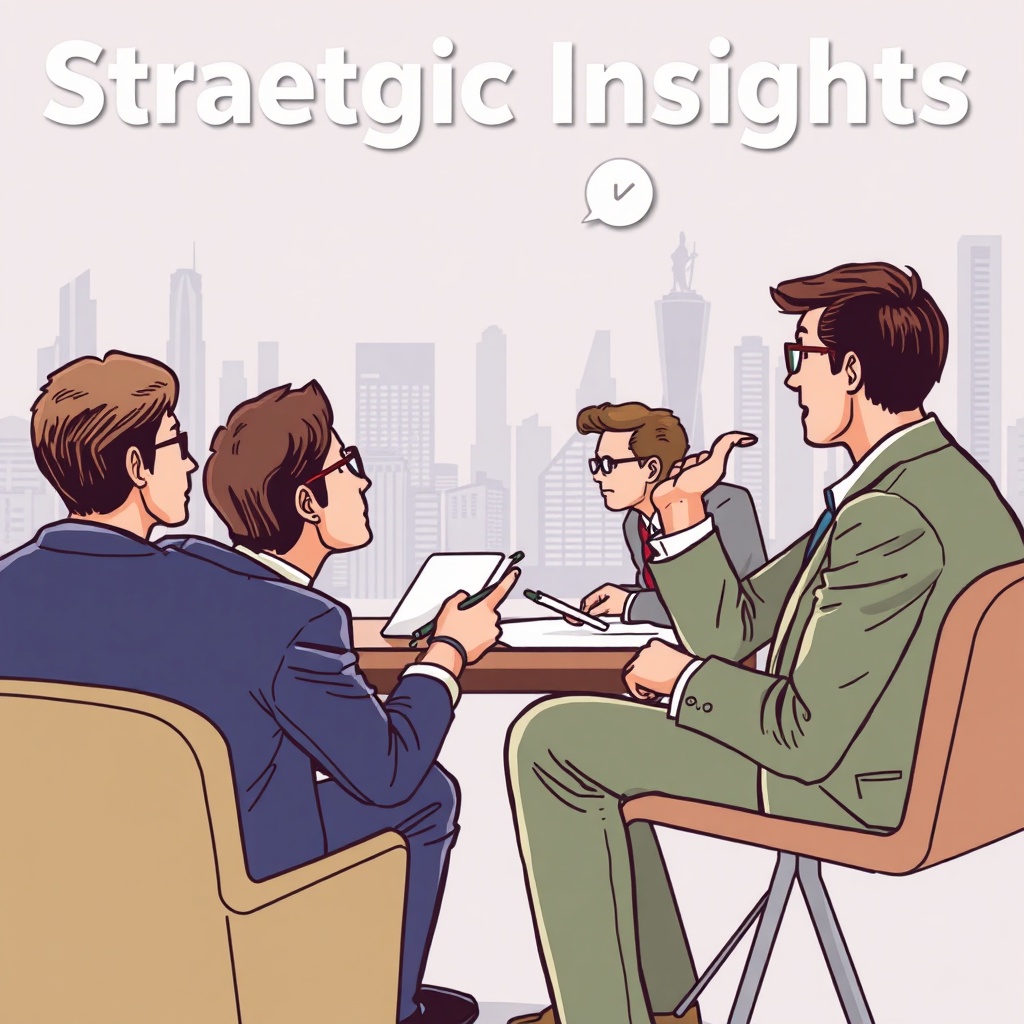
Strategic insights turn data into advantage. Organizations that translate signals into clear choices outperform peers because they move from reactive firefighting to proactive shaping of markets.
Strategic insights are not just analytics outputs; they are the disciplined processes, perspectives, and practices that turn ambiguity into action.
What strategic insights look like
– A concise hypothesis about where value will be created or lost.
– Evidence that links customer behavior, market shifts, and internal capabilities.
– A prioritized set of options with expected outcomes and confidence levels.
– A short learning plan to test assumptions quickly and cheaply.
A simple framework to generate insights faster
1.
Define the decision question: Frame the specific choice the insight will inform. Narrowing the question reduces noise and focuses research.
2.
Map the evidence: Gather quantitative signals (usage metrics, market share, financials) and qualitative signals (customer interviews, frontline feedback, competitor moves). Use triangulation to increase confidence.
3.
Assess impact and uncertainty: Score options by potential value and level of uncertainty. Use confidence intervals or a simple 1–5 rating to make trade-offs visible.
4. Design small bets: Convert high-uncertainty, high-upside options into experiments—pilot offers, A/B tests, or micro-launches that minimize resource exposure.
5. Institutionalize learnings: Capture outcomes, update models, and make the insight repeatable across teams.
Tools and techniques that deliver reliable insight
– Scenario planning: Create a few plausible future states and test strategies against each. This reduces single-point forecasting risk and surfaces robust options.
– Competitive intelligence: Track competitor moves, partnerships, and hiring signals to detect strategic shifts early.
– Customer journey analytics: Combine behavioral data with targeted interviews to reveal friction and unmet needs.
– Red teaming and premortems: Force teams to challenge assumptions and imagine how plans could fail, revealing hidden risks.
– Decision dashboards with confidence indicators: Pair leading KPIs with a qualitative confidence score so decision-makers see both performance and uncertainty.
Common pitfalls to avoid
– Confirmation bias: Validate assumptions with disconfirming evidence; intentionally seek voices that disagree.
– Paralysis by analysis: Don’t let perfect information be the enemy of timely action. Use iterative testing to reduce uncertainty.
– Misaligned metrics: Avoid optimizing vanity metrics. Tie indicators to customer outcomes and economic impact.
– Siloed insight creation: Cross-functional teams surface richer signals than isolated analytics or strategy groups.
Operational tips for scaling insight capability
– Embed analysts in product and commercial teams to shorten feedback loops.
– Use hypothesis-driven roadmaps: State the hypothesis, expected customer behavior, and success metrics for every initiative.
– Automate signal detection: Set alerts for market anomalies—pricing moves, supply chain disruptions, or sudden churn spikes—so teams can act early.
– Reward learning: Recognize experiments that deliver actionable learning, not just those that hit financial targets.
Make strategic insight a habit
Turn insight generation into a repeatable cycle: define the decision, gather signals, test assumptions, and then update plans. Organizations that adopt this rhythm move faster, make better trade-offs, and preserve optionality when conditions change.
Start small—apply the framework to one high-impact decision, learn the routine, then scale the practice across the organization.